Jamie Angel: When the Forest Becomes a Way of Cooking
2026.09.26
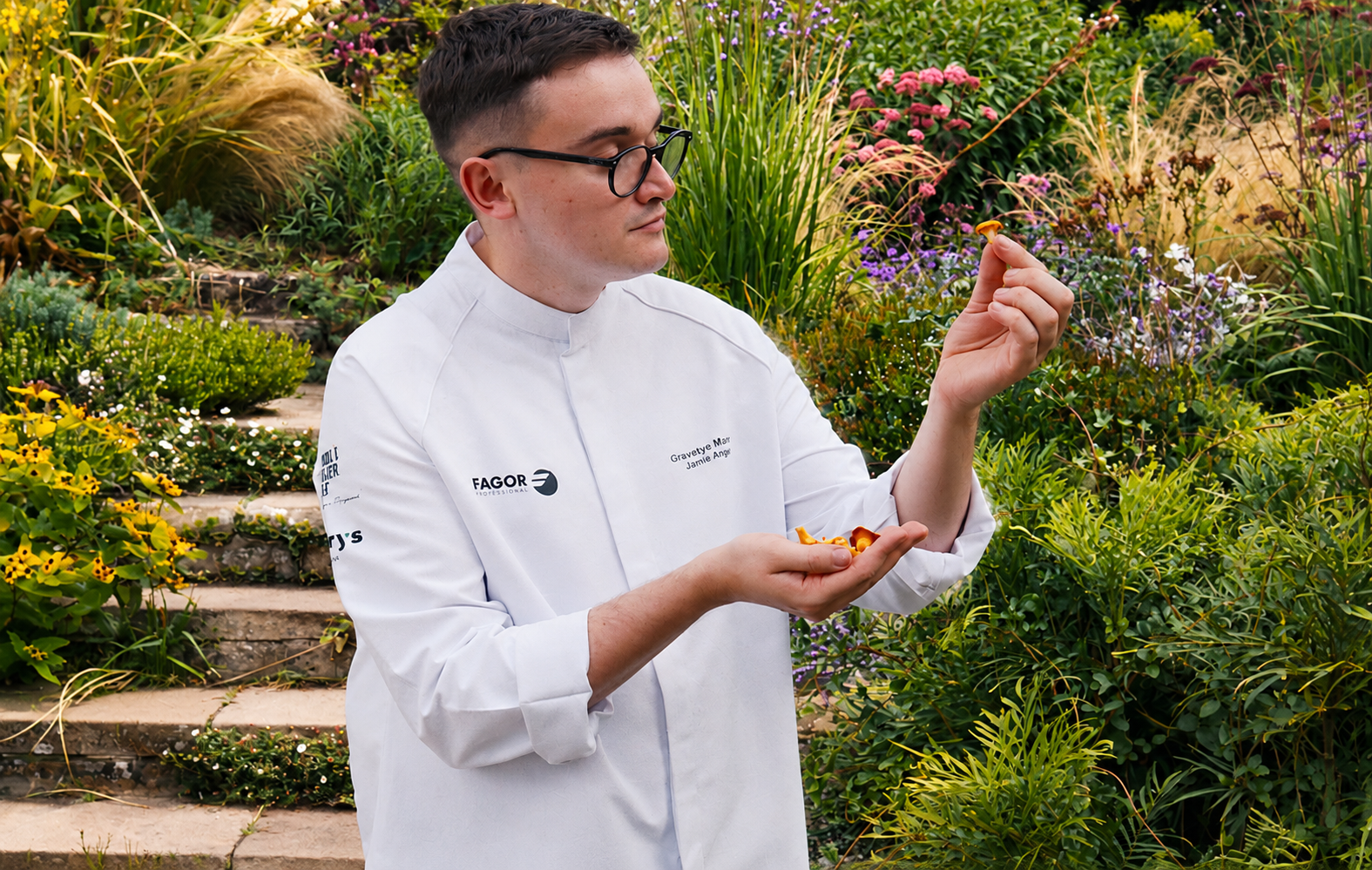
For Jamie Angel, some of the memories that best explain his cuisine begin not in a restaurant, but among the trees of the New Forest.
Born in Southampton, in the south of England, the British chef has built a career in which produce, seasonality and landscape have come to play an increasingly important role. He is currently Head Chef at Gravetye Manor in West Sussex, whose restaurant holds a Michelin star. On November 16, this approach to gastronomy will arrive in Madrid, where Angel will represent the United Kingdom as one of the eight international finalists of World’s Creative Chef by Fagor Professional.
The competition will bring together chefs from different countries and culinary cultures around a shared question: how far can creativity go when technique, innovation and technology are placed at the service of an idea? Each finalist will be challenged to develop and present a creation that reflects their own culinary vision before an international jury.
In Jamie Angel’s case, that vision seems to begin long before stepping into a professional kitchen. It begins with a landscape.
The forest as memory
The New Forest, in the south of England, is part of Jamie Angel’s childhood memories. Years later, those walks have also become a source of culinary inspiration.
Learning the craft through produce
Jamie Angel began working professionally with ingredients while still a teenager. The reference to the age of sixteen is no coincidence: Angel himself has pointed to that moment when recalling that venison was the first protein he learned to prepare professionally.
Since then, his career has developed in some of the most recognised gastronomic establishments in the south of England. Before joining Gravetye Manor, he worked at restaurants including L’Ortolan and The Montagu Arms, building a career closely connected to British fine dining.
That journey helps explain a cuisine in which technique and precision coexist with a particular attention to the origin of each ingredient.
One idea appears repeatedly when Angel speaks about his work: the relationship between seasonality, place and craft.
It is not simply about working with a particular ingredient because it happens to be available. The season shapes the landscape, and the landscape shapes what reaches the kitchen. Cooking thus becomes a way of interpreting a particular moment of the year.
This approach finds an especially meaningful setting in the place where he currently develops his cuisine.
Gravetye Manor: cooking with the seasons
In West Sussex, surrounded by the English countryside, Gravetye Manor provides a setting particularly well suited to this way of understanding gastronomy.
Angel currently works there as Head Chef. Taking on this role also marks a new stage in a career that previously saw him serve as Senior Sous Chef at the property under Executive Chef Martin Carabott, the 2018 Roux Scholar.
The surroundings allow landscape, produce and cuisine to remain in constant dialogue. For a chef whose identity is shaped by seasonality and place, working in this environment also means observing how the world around him changes and translating those changes onto the plate.
This relationship between nature and cuisine helps explain why seemingly simple elements — a mushroom, an animal associated with the forest or the memory of damp earth — can become the starting point for a gastronomic creation.
From this perspective, creativity does not necessarily mean moving away from what is familiar.
Sometimes it means looking at it more deeply.
Making the most of what is there before adding more
Another element that emerges in Jamie Angel’s cuisine is a desire to use ingredients consciously and thoughtfully.
It is an especially relevant philosophy among a generation of chefs for whom innovation can no longer be measured solely by technical complexity. It also means asking how resources are used, what relationship exists with the people who produce them and what purpose each element ultimately serves on the plate.
Competition as a space for defining an identity
Culinary competitions have played an important role in Jamie Angel’s recent career.
In 2026, he was selected as one of the 18 regional finalists for The Roux Scholarship, one of the UK’s leading professional competitions for young chefs. His selection took him to London to compete alongside chefs from establishments including Hélène Darroze at The Connaught, The Ritz, HIDE, Coworth Park and Trinity.
That same year, he was also selected as one of the ten UK finalists in the S.Pellegrino Young Chef Academy Competition 2026–27. For that competition, he chose to tell the story of the New Forest through gastronomy.
World’s Creative Chef now presents a different challenge.
On November 16, Angel will represent the United Kingdom in Madrid alongside seven other international chefs. Created by Fagor Professional, the competition evaluates each creation from a perspective in which creativity, innovation and culinary vision play a central role.
The challenge is not simply to execute a recipe correctly.
It is about having something to say.
And this is where one of the most interesting aspects of the path Angel is building becomes apparent: the further he advances technically, the more he seems to return to deeply personal references.
Between technique and memory
Venison can simply be a protein.
In Jamie Angel’s cuisine, it can also represent the landscape of his childhood and the first ingredient of its kind that he learned to work with professionally.
Filled pasta can be a question of technique.
But it can also become a reference to his Italian grandmother.
And mushrooms can provide flavour and texture, while a broth made from them can attempt to evoke something as intangible as the smell of a forest after the rain.
It is precisely here that memory and technique stop functioning as separate elements.
Technique makes it possible to transform a memory without reproducing it literally. And memory gives technique a reason to exist.
This relationship helps explain a cuisine that does not need to abandon its references in order to feel contemporary. On the contrary, it finds in them the material from which to experiment.
From the New Forest to Madrid
When Jamie Angel arrives in Madrid to compete in the final of World’s Creative Chef by Fagor Professional, he will do so as the United Kingdom’s representative and as part of a generation of chefs reconsidering what it means to talk about territory within fine dining.
His career so far offers some clues as to where that exploration is heading.
The landscape of southern England. Seasonality. Making full use of ingredients. The precision acquired in fine-dining restaurants. An Italian grandmother. Venison prepared for the first time at the age of sixteen. Memories of walking through the New Forest. The smell of mushrooms and earth after the rain.
Seemingly small references that, brought together, are beginning to shape a culinary identity.
World’s Creative Chef will offer another opportunity to bring that identity to an international stage and transform it into a creation capable of speaking for itself.
Because perhaps culinary creativity does not always begin by searching for something no one has ever done before. Sometimes it begins by looking closely at what has always been there: an ingredient, a season, a landscape or a memory.
And finding a new way to cook it.
