


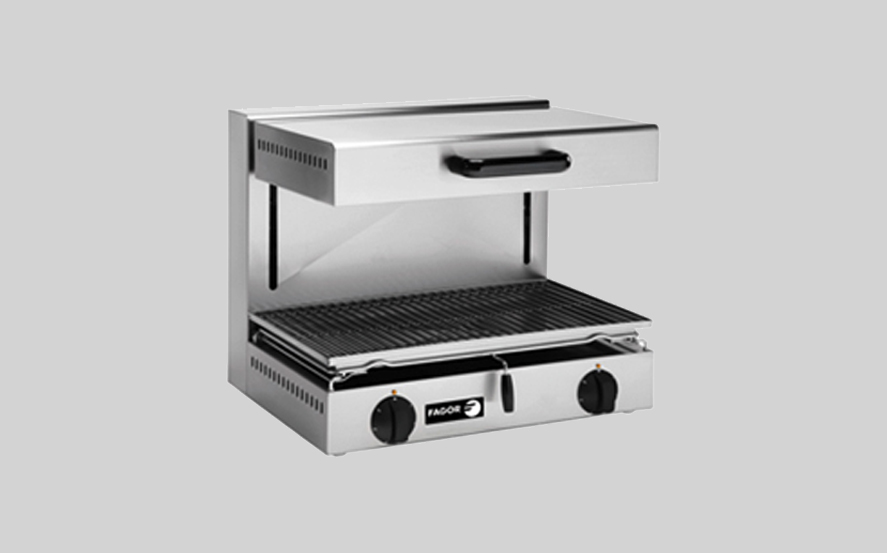
Thermal engineering and finish control in the professional kitchen salamander
In the final stage of service, the application of top heat requires an immediate response and great precision to work on the dish without disrupting the flow of the service. In this context, a professional kitchen salamander adds value when integrated as a dedicated finishing station, capable of concentrating rapid operations such as gratinating, reheating or browning without shifting this workload to other equipment less suited to the task.
When the serving line is handling several dishes simultaneously and needs to maintain a consistent flow of dishes, the presence of a salamander in the kitchen helps to relieve pressure on other hot zones and create a much more organised workflow. Its implementation is particularly useful in establishments where the final burst of heat forms an important part of the presentation and the operational rhythm of the service.
From a technical perspective, it is important to distinguish this type of solution from other enclosed cooking systems designed for prolonged processes. A salamander oven is best understood as a tool designed for rapid interventions on the surface of the dish, rather than as equipment intended for primary continuous cooking processes. In projects where the kitchen needs to achieve quick finishes without constantly relying on conventional ovens, a salamander oven helps to bolster the serving area and maintain a much more agile response during periods of high operational intensity.
Operational versatility and adaptation to the pace of service
In kitchens where gratin is a regular feature on the menu, incorporating a salamander oven for gratin helps maintain consistency in the finish and avoids unnecessary movement within the hot zone. This type of setup improves the continuity of service and facilitates more efficient organisation during peak periods.
When a restaurant requires a compact solution for quick, repetitive finishing tasks, an electric gratin oven fits particularly well within professional kitchen set-ups that handle a high turnover of dishes and require consistent speed at the serving line.
In certain dining concepts, the finishing area must perform several simultaneous functions relating to toasting, regeneration and the rapid application of top heat. This is where a salamander toaster can provide a particularly useful solution for maintaining order and operational continuity without overburdening other kitchen equipment.
In cafés, food bars and businesses with a high volume of rapid, repetitive tasks, a bread-toasting salamander helps create a more autonomous workstation, capable of handling continuous operations without disrupting the overall flow of service.
Professional implementation and purchase analysis
When the kitchen requires a solution capable of integrating seamlessly into a high-intensity working environment, a catering salamander makes sense as part of a setup designed to maintain pace, continuity and speed during the final stage of service.
The wide range of models available means that kitchen salamanders must always be assessed based on the type of service, the operational volume and the level of specialisation actually required by the finishing area within each establishment.
In restaurants where service depends on very tight coordination between stations, the presence of a salamander in the kitchen allows for better distribution of certain quick tasks and prevents work from piling up at other main cooking stations.
When the equipment must withstand intensive cleaning and continuous use throughout the entire working day, a stainless-steel salamander provides a much more seamless integration within professional kitchens that prioritise durability, easy maintenance and operational continuity.
Specialisation of the serving line and continuity of service
When planning the design of the hot line or the renewal of equipment in a catering business, it is a common mistake to evaluate machinery based solely on the initial purchase cost. In fact, rather than assessing the price of a kitchen salamander in isolation, it is far more useful and strategic for the business’s profitability to analyse the actual impact that this type of heating solution will have on the daily organisation of dish service and on the kitchen’s ability to respond immediately during the most demanding service periods. Analysing how it reduces waiting times and how it maintains the serving temperature of dishes before they are sent out to the dining room helps to demonstrate that the true return on investment is not measured by the cost of the appliance, but by the efficiency it brings to the staff’s workflow.
The current market offers a wide variety of technological options, ranging from models with a movable lid to systems with high-speed heating elements, which often distracts attention from what really matters in the day-to-day running of a restaurant. Although many searches and enquiries within the sector remain focused on understanding, in theoretical terms, what a salamander is in a kitchen, in professional and high-volume environments what really matters is how this equipment contributes in practical terms to organising the sequence of final finishing touches, providing a precise burst of heat, a uniform gratin or critical heat retention that substantially improves the flow of service during periods of peak workload and a backlog of orders.
The area where dishes are plated and checked before being served to customers often becomes the main bottleneck in establishments if it lacks the appropriate technological support to manage the simultaneous processing of orders. When the serving station requires greater logistical autonomy and superior technical capability to make rapid adjustments to the finished product without relying on the main range of hobs, the inclusion of a salamander enables the creation of a much more specialised, agile workflow, ready to handle rapid last-minute operations without ever compromising the continuity of service or the organoleptic quality of the dishes.
Finally, the presence of a salamander in the kitchen truly comes into its own when it is integrated as a precision tool within the finishing station rather than merely as a heating aid, enabling improved operational coordination and a much smoother service flow.
